Why exporting is essential for productivity
Trade and productivity go hand in hand.
This article is the first in a three-part series exploring the key international trade challenges, opportunities, and policies for New Zealand.
We tend to think of trade as an outcome when it is also a means to other ends and a mechanism to lift productivity. For a small, advanced (and distant) economy, our ability to improve productivity depends on our firms’ connections to global markets, their specialisation, and how our domestic settings support international business.
How can trade support New Zealand’s productivity?
This article explores this question by examining how trade affects productivity, why New Zealand struggles to capture productivity gains from international trade, and why our export makeup matters.
Trade and productivity are tightly linked
Exporting can make firms more productive by exposing them to larger markets, greater competition, and (often) better inputs – in essence, an environment supportive of productivity gains.
An important distinction to make is productivity gains from trade at a firm level, versus a broader, macro-level. The trade-productivity link at the firm level is “patchy” because exporting firms are more productive in the first place. At the macro-level, it is generally accepted that greater openness to trade can lead to better access to technologies and innovations, stronger competition, and more efficient resource allocation. This can deliver “aggregate” gains in productivity.
New Zealand’s productivity challenges are well understood. Our small domestic market limits scale and the level of domestic competition, with only a small number of high-performing firms near the global frontier that participate in global markets. In small, advanced economies (SAEs), frontier firms are crucial for productivity performance.
These structural realities influence the extent to which New Zealand firms participate in international markets and New Zealand’s overall level of global engagement and, therefore, our productivity.
New Zealand underperforms on outward orientation relative to similar international counterparts
Despite being known as an “export nation”, New Zealand has the lowest small economy export share. Furthermore, New Zealand’s export share has declined over the past few decades while most SAEs have deepened their level of international engagement.
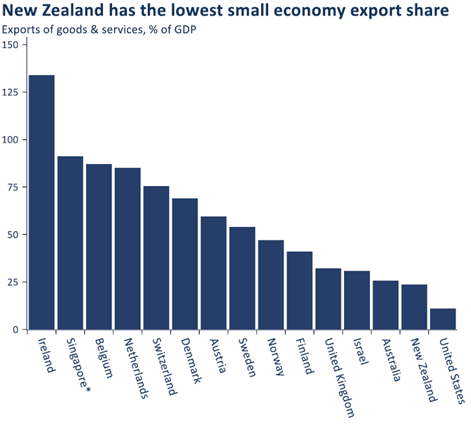
New Zealand does not perform comparatively well either in levels of research and development (R&D), foreign direct investment (FDI), or outward direct investment (ODI). By expanding international interactions, beyond just exports, SAEs have generated productivity spillovers from scale and specialisation. SAEs have been able to partly overcome their small domestic markets and build scale by engaging extensively in the global economy, specifically within internationally oriented sectors.
The makeup of our exports is equally as, if not more, important than how much we produce
Our current export profile limits the ability to engage in global value chains (GVCs), minimising the productivity gains we can capture from the intermediate points of GVCs that are filled with knowledge, innovation, and ideas.
Unlike many SAEs, New Zealand operates at the tail end of GVCs, as our exports are generally final products, limiting our ability to capture productivity gains through the networks associated with GVCs. This is evident in our primary sector, where we have some of our strongest international links, yet most of our exports are finished goods.
Our distance from other markets constrains our ability to be involved in GVCs, whether by exporting intermediate goods (“forward participation”) or by importing inputs for our exports ("backwards participation”). Other SAEs, particularly within Europe, actively participate in GVCs, meaning that their “frontier firms” can move up the value chain or expand into more specialised goods and services – where productivity gains can be realised.
What can New Zealand do better to realise productivity gains from trade?
To realise greater productivity gains from trade, New Zealand needs domestic settings that support our frontier firms to operate successfully in global markets. This includes regulatory quality, including competition policy, investment in both physical and digital infrastructure, and ensuring immigration settings are aligned to help firms access the capability they need.
This also includes supporting our primary sector to expand into higher-value, specialised areas, and the weightless economy, where New Zealand can more easily overcome distance, find scale, and build strong international connections. These settings shape the value of what we trade, not just the volume.
The next article in this three-part series will explore this further by asking how New Zealand can achieve its ‘double exports’ target?