What we can learn from Denmark’s productivity strategy
A major contributor to our productivity problem lies in ideas and technologies not spreading from leading firms to others across different industries.
The Treasury’s latest report highlights New Zealand’s persistent low productivity growth. Its analysis shows that after the global financial crisis and the pandemic; the slowdown has become a structural issue. Given these challenges, we should draw lessons from similar countries to lift productivity in New Zealand.
Persistent and structural low productivity growth in New Zealand
The report divides total productivity growth into two components:
Between industries – Workers or resources moving from one sector to another
Within industries – How efficiently businesses in each sector use their resources
Most of the slowdown comes from within industries.
Dynamics of within-industry productivity distribution
Low productivity has long been a challenge for New Zealand. The Productivity Commission’s Frontier Firms report provides a useful framework for understanding productivity distribution within sectors. A small group of high-performing firms sits close to the global frontier, while others lag behind both the domestic and international leaders. This gap matters because improvements at the frontier can influence the rest of the economy.
Within-industry effects depend on how innovation spreads, through the diffusion of better practices within sectors or diffusion across supply chains. Productivity grows when leading firms innovate and when those improvements spread across the rest of the industry.
A stylised model of firms’ productivity distribution
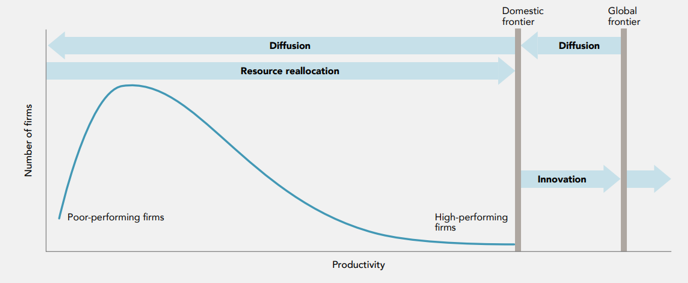
These patterns point to a simple truth: lifting productivity is not only about strong frontier firms, but also about creating conditions that help good ideas spread. Treasury notes that New Zealand can learn from other small advanced economies (SAEs) that have managed this well. To build on that, we look at Denmark’s experience and what practical policy we can learn from it.
What does Denmark’s experience look like?
New Zealand is a small, distant economy with a heavy reliance on the primary sector and relatively shallow capital markets. These factors make it harder for firms to scale, invest, innovate, and turn those actions into productivity growth.
The Frontier Firms report concludes that New Zealand’s productivity challenge lies within industries and is shaped by how firms operate. Most firms are small or medium-sized (SMEs), which limits economies of scale. Denmark, also a small and open economy where SMEs dominate, maintains high productivity through consistent policy settings.
Its 2021-2027 EU programme helps firms adopt digital tools, test new technologies, and move towards greener production. Denmark works closely with the European Development Fund (EDF) to support SMEs in becoming more innovative, digital, and sustainable.
Practical measures include:
- Small grants (vouchers) for businesses to invest in new technologies, improve energy efficiency, and test new products
- Shared training and innovation hubs to help firms learn from each other and overcome the limits of scale.
These steady efforts have paid off: Denmark's GDP per hour is now about 50 percent higher than New Zealand’s. Tailored support for SMEs has supported productivity growth.
Consistency matters
Denmark’s experience shows that steady, consistent actions enhance productivity. Policy needs to remain stable so that businesses can plan with confidence. Denmark’s consistent and practical steps give firms confidence and capacity to invest and innovate. Its approach reminds us that productivity grows from steady effort, not one-off policy.